
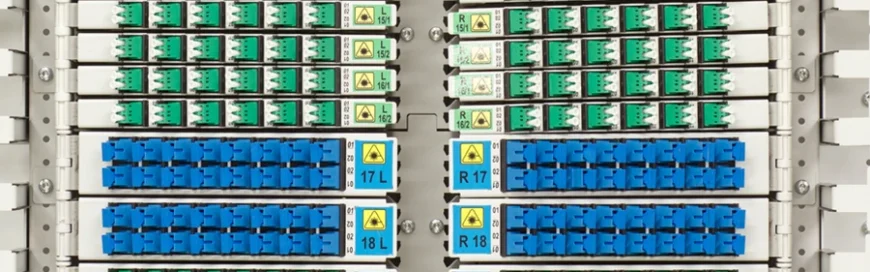
When most people think about network cabling, they usually imagine wires, connectors, and equipment. However, one of the most important parts of any structured cabling system often gets overlooked: how everything is labeled.
Without a consistent and well-thought-out labeling system, even the best cabling job can turn into a confusing mess. Finding ports, tracing cables, or making changes quickly becomes a guessing game. That is why at JabberComm, we treat labeling and documentation as essential from the start, not as an afterthought.
The Cost of Poor Labeling
Imagine walking into a building trying to find Jack 14. One room has jacks labeled D1 and D2. The next room’s jacks are numbered 10 and 11. Then, somewhere else, you come across D3 and D4. There is no order, no logic to the numbering, and no clear reason behind it. It is frustrating, and it wastes time.
When patch panels and faceplates lack a clear labeling system, troubleshooting slows down, upgrades become more difficult, and even simple changes cost more. Technicians end up spending more time tracing cables than fixing problems. This confusion often leads to longer downtimes because no one can quickly find the right connection.
Planning Comes First
Good labeling begins well before the first cable is pulled.
Every proper cabling project starts with prints and as-built drawings. These documents show the layout of the space, including where every faceplate will go. Each faceplate needs a clear and consistent identifier.
We recommend numbering jacks in a logical sequence that follows a pattern, such as moving clockwise from a fixed point in the office, like the main entrance. This creates a clear order that any technician can follow easily.
Labeling with a Logical Sequence
Here is an example:
The first office has a faceplate with two jacks labeled D1 and D2. The next office continues with D3 and D4. The following office has D5 and D6.
This approach is straightforward. It is clear and easy to follow no matter which way you move through the building.
What you want to avoid is inconsistent labeling like this:
The first office has D1 and D2. The second office is numbered 10 and 11. The third office returns to D3 and D4.
This breaks the sequence and forces anyone working on the system to backtrack, guess, or dig through outdated records, if those records exist at all.
Patch Panels Should Reflect the Field
The labeling on patch panels should match the labels on the faceplates.
Each port on the patch panel needs to correspond exactly with the faceplate and jack in the field. If Jack D1 is in the first office, then Port 1 on the patch panel should also be labeled D1. This kind of alignment creates a system that is easy to understand, even years after installation.
Labels should be clear, professionally printed, and consistent. At JabberComm, we use high-quality labels and follow industry standards to make sure everything is done right the first time.
Why Proper Labeling Matters
Structured cabling is a long-term investment. A good labeling system helps save time during troubleshooting, speeds up moves and changes, reduces the cost of future upgrades, limits reliance on tribal knowledge, and helps your IT staff or service provider work more efficiently.
Whether it is a small office or a large facility, a well-labeled infrastructure provides real operational value.
Conclusion: Label Your Cabling Like the Asset It Is
At JabberComm, we believe your cabling infrastructure is just as important as the technology it supports. That is why labeling, planning, and documentation are priorities on every project.
Clean patch panels, sequentially labeled jacks, and accurate as-built drawings may seem like small details, but they build a foundation that lasts.
If you are building, expanding, or organizing your facility, do more than just install cable; install order. Let us help you get it right.
Leave a comment!